MODULE 1: INTRODUCTION AND FUNDAMENTALS
Purpose: To introduce TPM concepts, the 8 pillars, OEE impact, and maintenance TPM.
Key Topics:
- Addressing the costs and benefits of maintenance.
- Transitioning from traditional "I run it, you fix it" mentalities to shared responsibilities.
- Introduction to the 8 Pillars: Focused Improvement, Autonomous Maintenance, Planned Maintenance, Training and Education, Early Management, Quality Maintenance, Administrative and
- Office, and Safety, Health, and Environment.
MODULE 2: OPERATIONAL PILLARS
- Visual Management (5S + 1): Implementing visual standards and systems to create a "model workplace" on the shop floor and in offices.
- Pillar I - Focused Improvement: Machining equipment effectiveness through the elimination of losses and minor stops.
- Pillar II - Autonomous Maintenance (AM): Engaging operators in maintaining their own machinery through inspections, lubrication, and simple repairs.
- The 7 Steps of AM: Initial clean-up, countermeasures for contamination, standards for cleaning/lubrication, overall inspection, AM standards, process quality assurance, and autonomous supervision.
- Tagging Process: Identifying and tracking issues using a TPM Tag Register.
MODULE 3: TECHNICAL AND SUPPORT PILLARS
- Pillar III - Planned Maintenance: Shifting the maintenance department toward high-tech tasks like overhauls and predictive maintenance while operators handle routine checks.
- Pillar IV - Training and Education: Developing a skill matrix and training plans for both operators and artisans.
- Pillar V - Early Management: Designing products and equipment for ease of use and maintainability to achieve controlling equipment conditions.
- Pillar VII - Administrative and Office: Applying 5S and process mapping to streamline information flow in support departments.
- Pillar VIII - Safety, Health, and Environment: Managing for zero accidents and cero pollution through hazard awareness training
MODULE 4: MANAGEMENT SYSTEMS AND FUTURE TRENDS
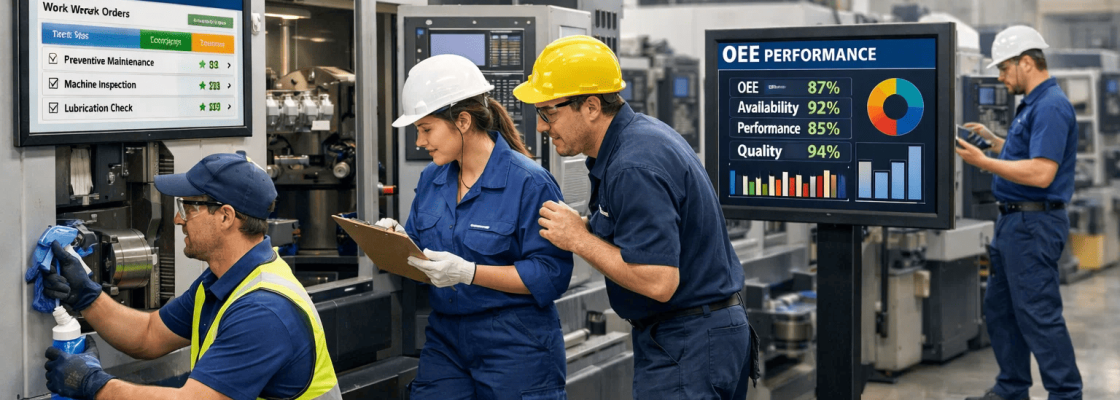
- Maintenance KPIs (OEE): Detailed formulas for calculating Overall Equipment Effectiveness and analyzing process losses.
- TPM Launch Roadmap: Implementing the "12 steps of TPM Development" through four stages: Preparation, Introduction, Implementation, and Stabilization.
- Case Study