
Why S&OP Fails — And What It Takes to Make It Work
Every planning team we've ever worked with has a version of the same story.
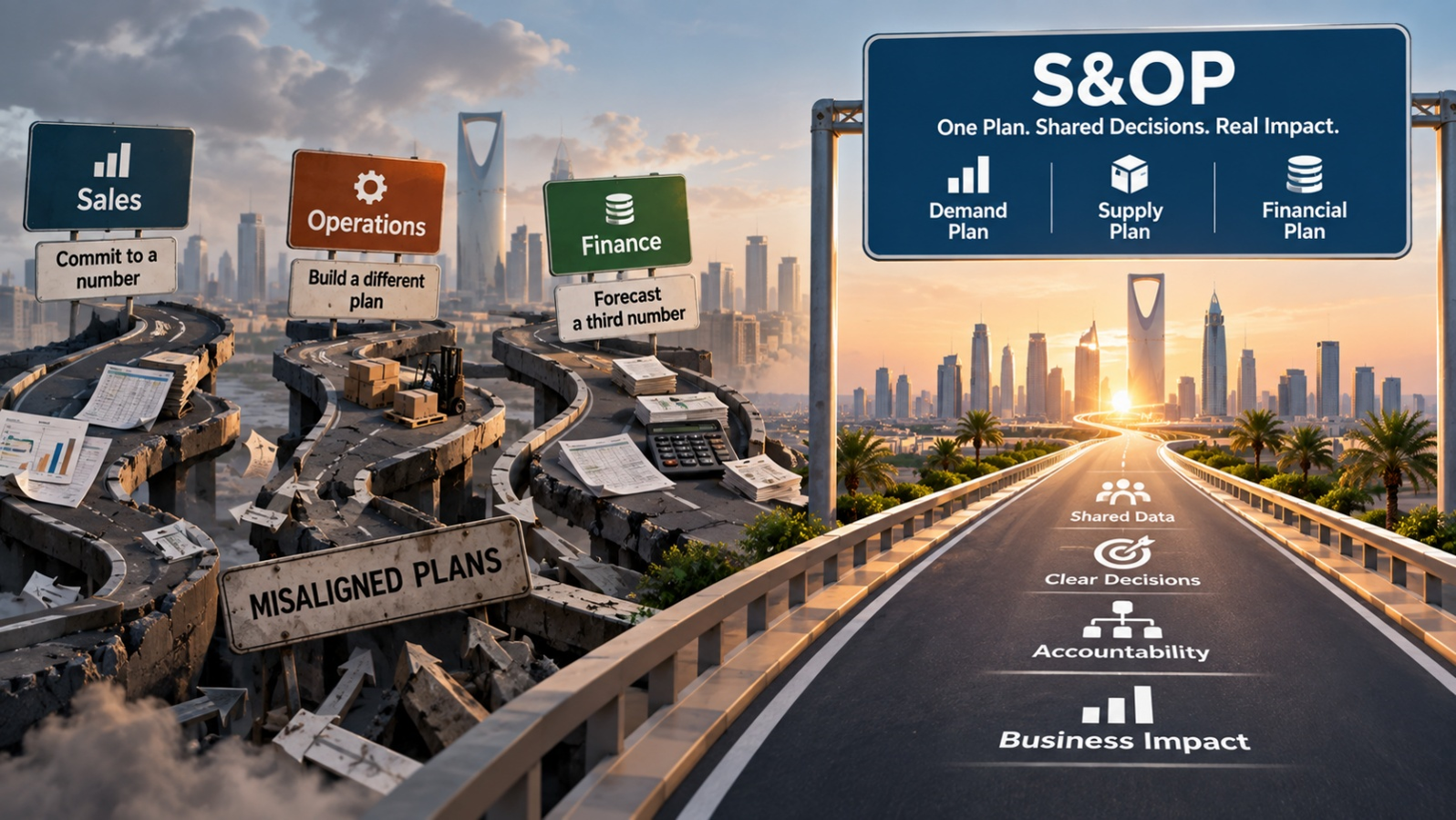
The sales team commits to a number. The operations team builds a plan around a different number. Finance is forecasting a third. By the time the monthly meeting happens, half the room is defending their spreadsheet, and the other half is firefighting last week's crisis.
Sales & Operations Planning — S&OP — exists precisely to solve it. And yet, in most organizations, it doesn't. Not really.
Here's what we've learned from designing and rebuilding S&OP systems across industries: the gap between “we have an S&OP process” and “our S&OP process actually works” is enormous. And it's almost never about the tools.
What S&OP Is Actually For
S&OP is a monthly management process that creates a single, agreed-upon plan across demand, supply, and finance — reviewed and approved by leadership.
Done well, it answers three questions every month:
What do we expect to sell?
Can we deliver it — and at what cost?
Does that outcome support our financial targets?
That sounds straightforward. But the reason most S&OP processes underperform is that organizations treat it as a reporting exercise rather than a decision-making process.
The Four Meetings That Drive the Cycle
A well-functioning S&OP process is built around four core conversations, each with a defined purpose and a clear output:
Demand Review
Sales, marketing, and planning come together to reconcile statistical forecasts with market intelligence. The goal is a single, validated view of what the market wants — before supply constraints are applied.
Output: Validated Demand PlanSupply Review
Operations, procurement, and logistics assess whether they can fulfill the demand plan. Capacity constraints are surfaced. Trade-offs are made explicit. The output is a realistic view of what the business can actually deliver.
Output: Feasible Supply PlanPre-S&OP Review
This is where the real work happens. Demand and supply gaps are reconciled. Scenario options are developed — with financial impact analysis for each. The outcome is a recommended plan ready for leadership.
Output: Recommended Integrated PlanExecutive S&OP
Leadership reviews the recommended plan and makes decisions. Not adjustments, not requests for more analysis — decisions. Approving the integrated plan and the financial commitments the business is making for the period ahead.
Output: One Committed Business PlanWhen these four conversations happen consistently, in sequence, with the right people and the right data, S&OP works. When any one of them breaks down, the whole cycle suffers.

Why Most S&OP Processes Break Down
In our experience, S&OP fails for one of four reasons — and usually a combination of all four:
No Real Governance
Everyone attends, but no one is accountable. When accountability is unclear, decisions get deferred. When decisions get deferred, the process becomes a formality.
Data Nobody Trusts
If the forecast accuracy number in the dashboard doesn't match what planners experience on the floor, people stop using the dashboard. S&OP runs on shared data — and shared data requires shared ownership.
Functional Silos Masquerading as Integration
Having sales and operations in the same room doesn't mean they're planning together. Real integration requires a shared language, a shared timeline, and a shared understanding of how each function's decisions affect the others.
No Connection to Financial Outcomes
When the S&OP plan isn't connected to the P&L, operations becomes a cost center and finance becomes a separate exercise. The most effective S&OP processes we've built treat financial impact as a core input to every decision — not an afterthought.
What Sustainable S&OP Looks Like
The organizations that get S&OP right share a few things in common.
Clear Process Ownership
They have a clear process owner — someone who doesn't just chair meetings, but manages the cycle, holds the timeline, and escalates when the process breaks down.
Forecast Accuracy as a KPI
They treat forecast accuracy as a KPI, not just a metric — meaning there are consequences and conversations when it falls, not just a number on a report.
Monthly Discipline
They run the cycle consistently, every month, regardless of whether things are going well. S&OP is most valuable when the business is under pressure — but only if the muscle has been built when things are calm.
Planning Capability
They invest in the people behind the process. Tools and dashboards are enablers. The planning capability of your team is the actual competitive advantage.
The Question Worth Asking
If your organization has an S&OP process, the question isn't whether it exists — it's whether it's actually driving decisions.
Effective S&OP
Decision-DrivenUnderperforming S&OP
Meeting-DrivenAre your executives walking out of the monthly review with a clear, committed plan? Or are they walking out with a list of follow-up actions and a vague sense that more analysis is needed?
If it's the latter, the process needs to be rebuilt — not tweaked.
That's the work we do.
Make S&OP a Management System — Not a Monthly Meeting.
Symbios Consulting Group designs, builds, and embeds S&OP systems that connect strategic intent to operational execution.
Talk to Our Supply Chain Team